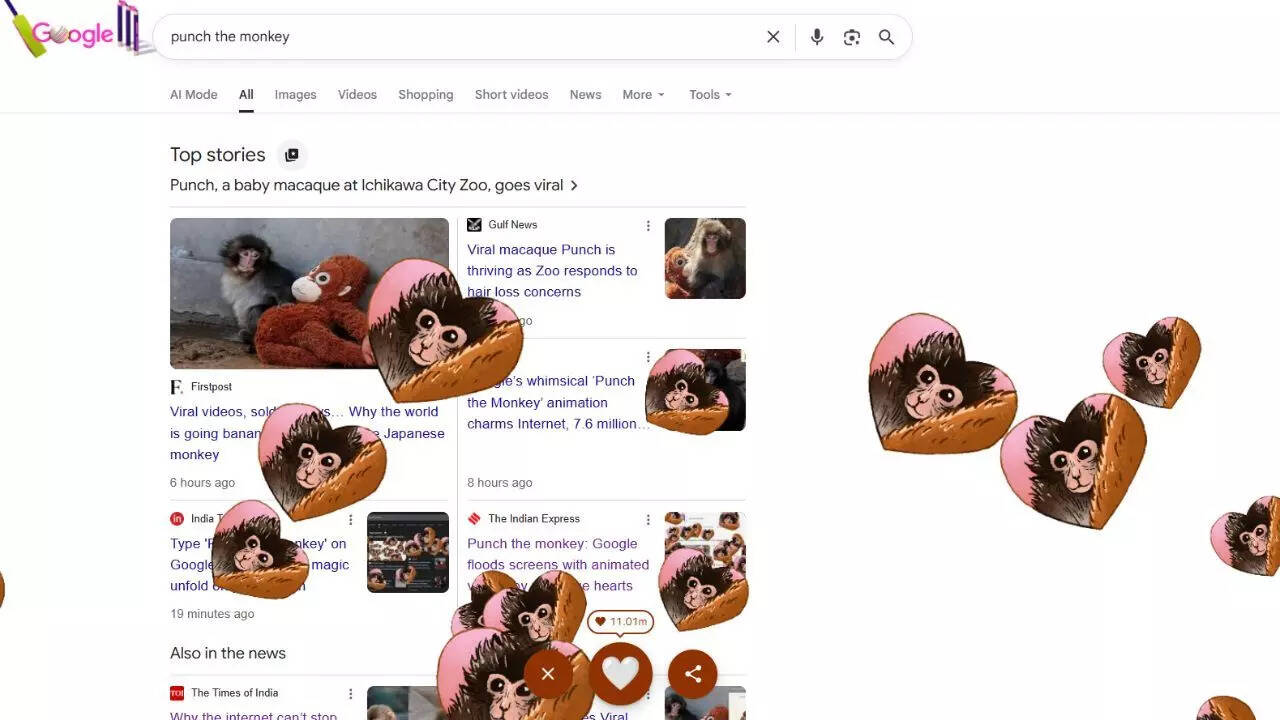
You might have noticed something strange happening on Google lately. Type in "Punch the monkey" and what do you get? A shower of bright pink hearts raining down your screen. That's right – Google itself created an entire animation just for this baby monkey. But here's the crazy part: Punch isn't a celebrity. He's not a musician or an actor. He's a 7-month-old Japanese macaque living at a zoo near Tokyo who somehow became the internet's newest obsession in just a few weeks.
How It All Started: A Zoo Post That Broke the Internet
Back in February 2026, the Ichikawa City Zoo posted something pretty simple – just an update about a baby monkey named Punch who had been abandoned by his mother. Nothing too unusual for a zoo's social media, right? But this post hit different. Punch wasn't just any orphaned monkey. He was this tiny, wide-eyed creature who had been given an IKEA orangutan plush toy as a surrogate mother. And people lost it.
Within days, the post went viral in Japan. Then it spread across Asia. Then Europe. Then the whole world was obsessed with this baby monkey clinging to a stuffed animal. The hashtag #がんばれパンチ (which means "Hang In There Punch") started trending everywhere. People who didn't even like monkeys were suddenly emotionally invested in this little guy's life.
Within days, the post went viral in Japan. Then it spread across Asia. Then Europe. Then the whole world was obsessed with this baby monkey clinging to a stuffed animal. The hashtag #がんばれパンチ (which means "Hang In There Punch") started trending everywhere. People who didn't even like monkeys were suddenly emotionally invested in this little guy's life.
Why the Internet Went Crazy for Punch
Let's be real – the internet loves animal content. But Punch's story hit different, and psychologists and culture writers have been trying to figure out why ever since. Here's what they think is going on:
People started typing stuff like "I am Punch and he is me" in family group chats. LA Times writer Mary McNamara's daughter literally sent that exact message, and honestly? Same.
- Relatability: Everyone knows what it feels like to be rejected or left out. Punch getting pushed away by other monkeys? That's middle school trauma in animal form.
- Underdog energy: This tiny abandoned monkey finding comfort in a toy? Classic underdog story that humans have eaten up for centuries.
- Comfort object nostalgia: Who didn't have a stuffed animal or blanket they loved as a kid? Punch clinging to his IKEA orangutan hits that same emotional place.
- Collective empathy: For once, the whole internet agreed on something. No politics, no arguments – just everyone rooting for a baby monkey to make friends.
People started typing stuff like "I am Punch and he is me" in family group chats. LA Times writer Mary McNamara's daughter literally sent that exact message, and honestly? Same.
The Viral Moments That Made Punch Famous
Punch didn't become famous overnight from just one post. It was a series of moments that kept people coming back for more:
The First Viral Video: A clip of Punch being dragged away by adult macaques broke everyone's hearts. Zoo officials said it was normal monkey behavior, but the internet saw bullying and rejection.
The Plushie Bond: Then came videos of Punch cuddling with his IKEA orangutan toy, which fans nicknamed "Oran-Mama" or "Oran-Mother." Watching him drag this plushie around like it was his actual mom? Emotional damage.
The Breakthrough: Finally, footage showed Punch making friends with other monkeys. The internet collectively breathed a sigh of relief. Some people questioned whether these new friends were genuine or just attracted to Punch's sudden celebrity status (valid question tbh).
The Google Easter Egg: When Google added the hearts animation, that's when you know you've made it. Tech analysts said this was one of the fastest Google tributes ever deployed, triggered purely by how many people were searching for Punch.
The First Viral Video: A clip of Punch being dragged away by adult macaques broke everyone's hearts. Zoo officials said it was normal monkey behavior, but the internet saw bullying and rejection.
The Plushie Bond: Then came videos of Punch cuddling with his IKEA orangutan toy, which fans nicknamed "Oran-Mama" or "Oran-Mother." Watching him drag this plushie around like it was his actual mom? Emotional damage.
The Breakthrough: Finally, footage showed Punch making friends with other monkeys. The internet collectively breathed a sigh of relief. Some people questioned whether these new friends were genuine or just attracted to Punch's sudden celebrity status (valid question tbh).
The Google Easter Egg: When Google added the hearts animation, that's when you know you've made it. Tech analysts said this was one of the fastest Google tributes ever deployed, triggered purely by how many people were searching for Punch.
From Local Zoo to Global Fame: What Happened Next
The Punch Effect was real and very measurable. Here's what went down:
- Zoo attendance exploded: Huge lines formed outside Ichikawa City Zoo. So many people showed up that zoo officials had to apologize for entry delays – something that had literally never happened before.
- The IKEA craze: Remember that Djungelskog orangutan plushie? It sold out in multiple countries. People started reselling them on eBay for up to $350 (original price: around $20-30). The demand was so insane that IKEA actually donated 33 stuffed toys to Punch and the zoo.
- International media coverage: This wasn't just a Japan thing anymore. Major outlets from NBC to the New York Times to the Guardian were covering Punch's story like he was a celebrity.
- Global fandom: Social media was flooded with messages like "We're ALL Punch's family now" and "We're not okay." People who had never been to Japan, never seen a snow monkey in person, were emotionally invested in this baby's well-being.
Why Punch's Viral Fame Actually Matters
Sure, viral animal stories come and go. But there's something about Punch that feels different. As USA Today columnist Louie Villalobos put it, Punch reminds us of our own loneliness and rejection, but also teaches us about hope and perseverance.
That's pretty deep for a baby monkey story.
Punch became viral not because he was cute (though, obviously) but because his struggle was so universally human. Being abandoned, trying to fit in, finding comfort wherever you can – that's a story that transcends species and language barriers. In a world where the internet usually divides us, Punch brought millions of people together in collective empathy.
And honestly? We needed that.
That's pretty deep for a baby monkey story.
Punch became viral not because he was cute (though, obviously) but because his struggle was so universally human. Being abandoned, trying to fit in, finding comfort wherever you can – that's a story that transcends species and language barriers. In a world where the internet usually divides us, Punch brought millions of people together in collective empathy.
And honestly? We needed that.
Today, Punch is reportedly doing well – playing with other monkeys and eating without help from caretakers. But his viral moment shows something bigger about how the internet works now. It's not just about funny memes or viral dances anymore. Sometimes, it's about a baby monkey in Japan who makes the whole world stop and think about loneliness, rejection, and the universal need to belong. Now if you'll excuse me, I need to go search for Punch on Google one more time for those hearts.